
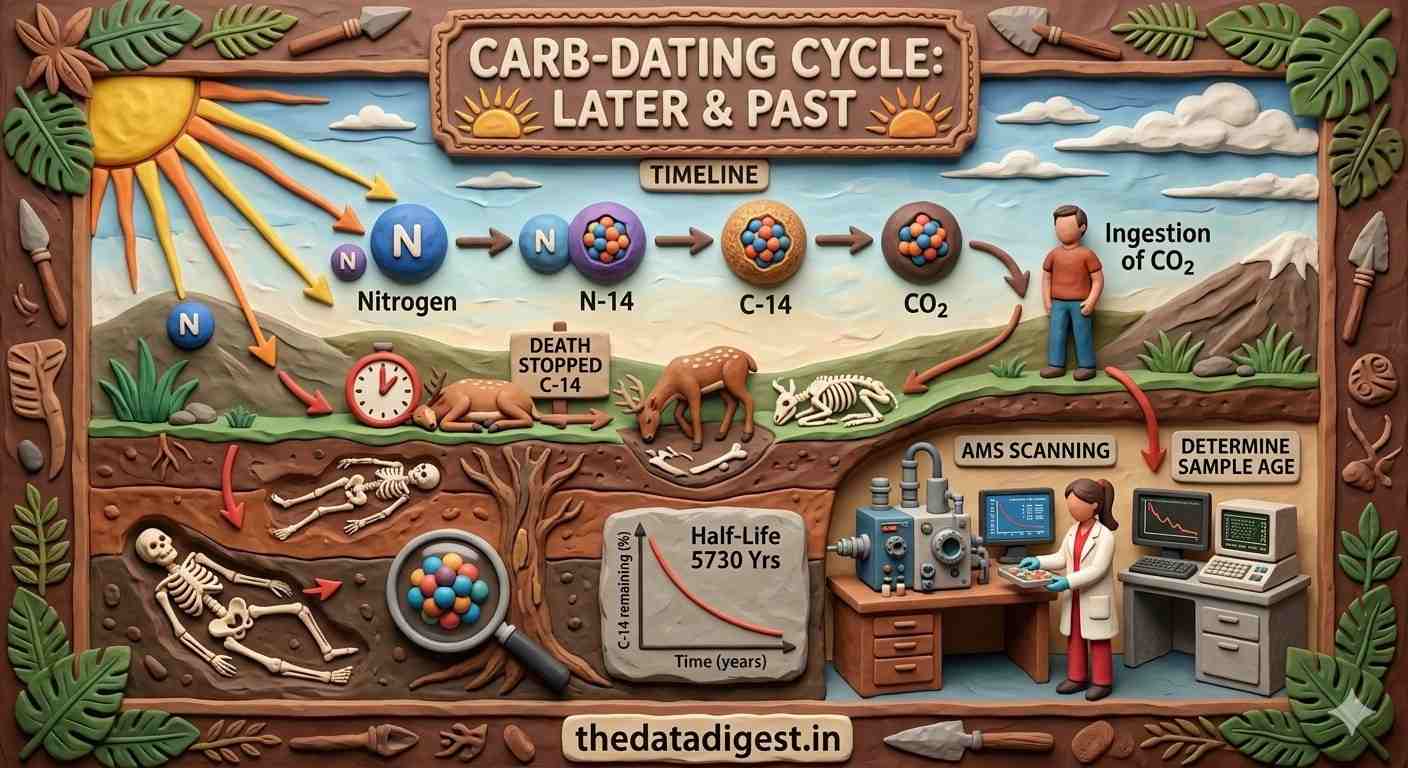
Carbon Dating क्या है? Carbon-14 Dating कैसे काम करती है और किसी चीज़ की उम्र कैसे पता चलती है?
अगर किसी पुरानी लकड़ी, हड्डी, कपड़े, बीज या archaeological site से मिले organic material की उम्र पता करनी हो, तो वैज्ञानिक Carbon Dating या Radiocarbon Dating जैसी वैज्ञानिक तकनीकों का इस्तेमाल करते हैं।
लेकिन Carbon Dating क्या है? Carbon-14 क्या होता है? इसकी Half-Life कितनी होती है? वैज्ञानिक कैसे पता लगाते हैं कि कोई sample हजारों साल पुराना है? और Carbon Dating कितनी accurate होती है?
- Carbon Dating क्या है?
- Carbon-14 क्या है?
- Carbon-14 बनता कैसे है?
- Living Organism में Carbon-14 कैसे पहुँचता है?
- मृत्यु के बाद Carbon-14 के साथ क्या होता है?
- Carbon Dating कैसे काम करती है?
- Carbon-14 की Half-Life क्या है?
- Carbon Dating से Age कैसे Calculate होती है?
- किन चीज़ों की Carbon Dating की जा सकती है?
- किन चीज़ों की Carbon Dating नहीं की जा सकती?
🧪 Carbon Dating क्या है?
Carbon Dating एक वैज्ञानिक dating method है जिसका उपयोग मुख्य रूप से उन organic materials की उम्र का अनुमान लगाने के लिए किया जाता है जो कभी living organisms का हिस्सा रहे हों।
इसे Carbon-14 Dating और Radiocarbon Dating भी कहा जाता है।
इस technique का आधार Carbon-14 (¹⁴C) नामक radioactive isotope है।
इसलिए Carbon Dating को एक तरह की natural radioactive clock के रूप में समझा जा सकता है।
⚛️ Carbon-14 क्या है?
Carbon एक chemical element है जिसके कई isotopes होते हैं। इनमें Carbon-12, Carbon-13 और Carbon-14 विशेष रूप से महत्वपूर्ण हैं।
| Isotope | स्थिति | विशेषता |
|---|---|---|
| Carbon-12 (¹²C) | Stable | Carbon का प्रमुख stable isotope |
| Carbon-13 (¹³C) | Stable | Natural carbon में पाया जाता है |
| Carbon-14 (¹⁴C) | Radioactive | Radiocarbon Dating में मुख्य isotope |
Carbon-14 unstable होता है और समय के साथ radioactive decay करता है। इसी predictable decay की वजह से इसका उपयोग age estimation में किया जा सकता है।
🌌 Carbon-14 बनता कैसे है?
Carbon-14 का natural cycle पृथ्वी के atmosphere से जुड़ा हुआ है। अंतरिक्ष से आने वाली cosmic radiation पृथ्वी के upper atmosphere में मौजूद particles के साथ interaction करती है।
इन processes के कारण nitrogen atoms से Carbon-14 का निर्माण हो सकता है। यह Carbon-14 atmospheric carbon cycle में शामिल हो जाता है।
🌱 Living Organism में Carbon-14 कैसे पहुँचता है?
Carbon-14 atmosphere में carbon cycle का हिस्सा बन सकता है। Plants photosynthesis के दौरान atmospheric carbon dioxide ग्रहण करते हैं।
इसके बाद food chain के माध्यम से यह carbon animals और humans तक पहुँचता है।
जब organism जीवित होता है, तब उसके environment के साथ carbon का continuous exchange होता रहता है। इसलिए उसके tissues में Carbon-14 मौजूद रहता है।
⚰️ मृत्यु के बाद Carbon-14 के साथ क्या होता है?
Carbon Dating का सबसे महत्वपूर्ण हिस्सा यही है।
जब कोई plant या animal मर जाता है, तो उसका environment के साथ सामान्य biological carbon exchange रुक जाता है। नया Carbon-14 शरीर में उसी तरह replenish नहीं होता।
लेकिन जो Carbon-14 पहले से मौजूद है, वह radioactive decay करता रहता है।
मृत्यु के बाद: नया biological carbon exchange बंद हो जाता है और मौजूद Carbon-14 धीरे-धीरे decay करता रहता है।
यही radioactive decay वैज्ञानिकों को sample की age estimate करने में मदद करता है।
🔬 Carbon Dating कैसे काम करती है?
Carbon Dating को समझने के लिए इसे कुछ basic steps में बाँट सकते हैं।
1️⃣ Suitable Sample लिया जाता है
सबसे पहले किसी archaeological या historical context से suitable organic sample लिया जाता है। उदाहरण के लिए wood, charcoal, bone, textile, leather या plant remains।
2️⃣ Sample को Prepare और Clean किया जाता है
Laboratory में sample को carefully process किया जाता है ताकि unwanted material और संभावित contamination को कम किया जा सके।
3️⃣ Carbon Isotopes को Measure किया जाता है
Laboratory sample में मौजूद Carbon-14 और अन्य carbon isotopes से संबंधित measurements करती है। Modern laboratories में Accelerator Mass Spectrometry (AMS) जैसी techniques इस्तेमाल की जा सकती हैं।
4️⃣ Radioactive Decay को Analyse किया जाता है
Sample में बचे Carbon-14 के आधार पर यह estimate किया जाता है कि organism के biological carbon cycle से अलग होने के बाद कितना समय बीता है।
5️⃣ Calibration की जाती है
Raw radiocarbon measurement को सीधे calendar year समझना सही नहीं होता। Atmospheric Carbon-14 में historical changes होने के कारण calibration curves का उपयोग किया जाता है।
⏱️ Carbon-14 की Half-Life क्या है?
Carbon-14 की half-life लगभग 5,730 years मानी जाती है।
Half-life का मतलब यह नहीं है कि 5,730 साल बाद Carbon-14 पूरी तरह खत्म हो जाता है। इसका मतलब है कि इतने समय में radioactive Carbon-14 की लगभग आधी मात्रा decay हो जाती है।
| समय | लगभग बचा Carbon-14 |
|---|---|
| शुरुआत | 100% |
| 5,730 वर्ष | 50% |
| 11,460 वर्ष | 25% |
| 17,190 वर्ष | 12.5% |
| 22,920 वर्ष | 6.25% |
| 28,650 वर्ष | 3.125% |
🧮 Carbon Dating से Age कैसे Calculate की जाती है?
Basic concept radioactive decay पर आधारित है। जैसे-जैसे समय बीतता है, sample में मौजूद Carbon-14 की मात्रा घटती जाती है।
उदाहरण के लिए, अगर hypothetical sample में लगभग 50% original Carbon-14-equivalent amount बची है, तो यह लगभग एक half-life के बराबर decay का संकेत दे सकता है।
Carbon-14 की half-life लगभग 5,730 years होने के कारण simplified example में यह लगभग 5,730 years के आसपास का age estimate दे सकता है।
इसी तरह लगभग 25% remaining amount लगभग दो half-lives के बराबर होगी:
वास्तविक scientific calculation इससे अधिक complex होती है क्योंकि measurement uncertainty, calibration, sample history और अन्य corrections को ध्यान में रखना पड़ता है।
🪵 किन चीज़ों की Carbon Dating की जा सकती है?
Carbon Dating मुख्य रूप से ऐसे materials के लिए उपयोगी है जिनमें biological carbon सुरक्षित रहा हो।
| Sample | Carbon Dating में उपयोग |
|---|---|
| 🌳 Wood | पुरानी लकड़ी की chronology estimate करने में उपयोगी |
| 🔥 Charcoal | Archaeological sites में common sample |
| 🦴 Bone | Suitable preserved organic component होने पर |
| 🌾 Seeds / Plant Remains | Archaeological और environmental research |
| 👕 Textile | Suitable organic fibres होने पर |
| 👜 Leather | Animal-derived organic material होने के कारण कुछ cases में |
| 📜 Paper | Suitable plant-derived carbon preserved होने पर |
❌ किन चीज़ों की Carbon Dating नहीं की जा सकती?
यह मानना गलत है कि Carbon Dating से हर पुरानी वस्तु की उम्र पता की जा सकती है।
सामान्यतः Carbon-14 dating suitable organic material के लिए होती है। इसलिए ordinary stone, अधिकांश metals और बहुत पुराने geological materials के लिए दूसरे dating methods की आवश्यकता हो सकती है।
❌ अधिकांश Metals → Carbon Dating सामान्यतः उपयुक्त नहीं
❌ करोड़ों साल पुराने Geological Materials → अन्य dating methods
✅ Wood → Suitable cases में उपयोगी
✅ Charcoal → Archaeology में महत्वपूर्ण
✅ Suitable Bone → कुछ परिस्थितियों में उपयोगी
✅ Plant Remains → Suitable samples में उपयोगी
🎯 Carbon Dating कितनी Accurate है?
Carbon Dating एक scientifically established dating technique है, लेकिन इसका result किसी वस्तु की उम्र को हमेशा एक single exact number के रूप में नहीं बताता।
Radiocarbon measurement में uncertainty होती है और measured radiocarbon age को calendar age में समझने के लिए calibration की आवश्यकता हो सकती है।
इसके अलावा sample की quality, contamination, reservoir effects, laboratory measurement और archaeological context भी final interpretation को प्रभावित कर सकते हैं।
इसलिए किसी archaeological discovery की dating करते समय scientists केवल एक number देखने के बजाय sample की पूरी history, context और laboratory methodology को भी देखते हैं।
📊 Carbon Dating में Calibration क्या है?
Carbon Dating में प्राप्त raw radiocarbon measurement को सीधे calendar year मान लेना सही नहीं है।
इसका कारण यह है कि पृथ्वी के atmosphere में Carbon-14 की concentration हमेशा बिल्कुल समान नहीं रही।
Cosmic radiation, carbon cycle और अन्य environmental factors के कारण atmospheric radiocarbon levels समय के साथ बदलते रहे हैं।
इसलिए scientists ऐसे independently dated records का उपयोग करते हैं जिनसे past atmospheric radiocarbon variations को समझा जा सके।
🌳 Tree Rings की भूमिका
Tree rings कई परिस्थितियों में annual chronology प्रदान कर सकते हैं। इन records की मदद से radiocarbon measurements को calendar timescale के साथ बेहतर तरीके से relate किया जाता है।
↓
Calibration Curve + Scientific Corrections
↓
Calendar-Age Estimate
इसलिए modern radiocarbon dating में calibration एक महत्वपूर्ण step है।
🧪 Contamination Carbon Dating को कैसे प्रभावित कर सकती है?
Carbon Dating में sample contamination एक महत्वपूर्ण challenge है।
मान लीजिए कोई वास्तविक रूप से बहुत पुराना wooden sample laboratory में भेजा गया। अगर उसमें बाद में आया हुआ modern carbon मिल गया है, तो sample का measured Carbon-14 signal प्रभावित हो सकता है।
इससे calculated age वास्तविक age से अलग हो सकती है।
पुराना sample + modern carbon contamination
↓
Carbon-14 signal बदल सकता है
↓
Age estimate प्रभावित हो सकता है
इसी कारण laboratories sample preparation और cleaning को बहुत गंभीरता से लेती हैं।
🧼 Sample Preparation क्यों जरूरी है?
Laboratory को कोशिश करनी होती है कि वह sample के original biological carbon को analyse करे और बाहरी contamination को जितना संभव हो कम करे।
इसी वजह से sample selection और preparation radiocarbon dating की reliability में महत्वपूर्ण भूमिका निभाते हैं।
⏳ Carbon Dating की Maximum Age कितनी है?
Carbon-14 की half-life लगभग 5,730 years है। जैसे-जैसे sample पुराना होता जाता है, उसमें Carbon-14 की मात्रा बहुत कम होती जाती है।
इसी कारण radiocarbon dating की practical useful range आम तौर पर लगभग 50,000 से 60,000 years के आसपास मानी जाती है, हालांकि actual limit sample और measurement method पर निर्भर करती है।
| Sample Age | Carbon-14 की स्थिति | Dating Challenge |
|---|---|---|
| कुछ हजार वर्ष | पर्याप्त measurable Carbon-14 | आमतौर पर useful range |
| 10,000–30,000 वर्ष | Carbon-14 कम होता जाता है | Measurement और calibration महत्वपूर्ण |
| 40,000+ वर्ष | बहुत कम Carbon-14 | High-sensitivity measurement महत्वपूर्ण |
| 50,000–60,000 वर्ष के आसपास | बहुत छोटा remaining signal | Practical limits महत्वपूर्ण हो जाती हैं |
इसलिए Carbon Dating को millions या billions of years पुराने materials की general-purpose dating technique नहीं समझना चाहिए।
🦖 क्या Dinosaur की Carbon Dating हो सकती है?
यह Carbon Dating से जुड़ा सबसे popular सवालों में से एक है।
सामान्यतः Dinosaur fossils की age Carbon-14 Dating से निर्धारित नहीं की जाती।
इसका मुख्य कारण यह है कि dinosaurs करोड़ों साल पहले पृथ्वी पर रहते थे, जबकि Carbon-14 की practical dating range केवल tens of thousands of years तक है।
Dinosaur fossils बहुत ज्यादा पुराने हैं → Carbon-14 बहुत पहले ही अत्यंत कम हो चुका होगा → इसलिए Carbon-14 Dating उनकी geological age निर्धारित करने के लिए appropriate method नहीं है।
ऐसे बहुत पुराने geological materials के लिए scientists दूसरे radiometric dating systems और geological evidence का उपयोग करते हैं।
🏺 Archaeology में Carbon Dating का उपयोग
Archaeology में Carbon Dating का सबसे महत्वपूर्ण उपयोग ancient organic materials की chronology समझने में होता है।
उदाहरण के लिए scientists यह जानना चाह सकते हैं कि:
- कोई archaeological settlement लगभग किस period का है?
- किसी ancient fire से मिला charcoal कितना पुराना है?
- किसी wooden structure का material कब का है?
- किसी burial site में मौजूद suitable organic remains किस समय के हैं?
- किसी ancient plant या seed remains की age क्या हो सकती है?
इस तरह radiocarbon dating archaeological evidence को chronological framework देने में मदद कर सकती है।
🌍 Carbon Dating के वास्तविक उपयोग
| क्षेत्र | Carbon Dating का उपयोग |
|---|---|
| 🏺 Archaeology | Ancient organic remains की chronology समझना |
| 🧑🔬 Anthropology | Human history और archaeological remains का अध्ययन |
| 🌳 Environmental Science | Past carbon cycle और environmental records का अध्ययन |
| 🌎 Climate Research | Past environmental और carbon-cycle changes को समझना |
| 🏛️ Historical Research | कुछ historical organic materials की chronology में सहायता |
🧭 Carbon Dating और दूसरे Dating Methods में अंतर
Carbon Dating, radiometric dating की बड़ी category का एक हिस्सा है। अलग-अलग materials और age ranges के लिए अलग-अलग scientific methods उपयोग किए जाते हैं।
| Dating Method | मुख्य उपयोग |
|---|---|
| Carbon-14 Dating | Relatively recent suitable organic materials |
| Uranium-Lead Dating | बहुत पुराने geological materials |
| Potassium-Argon Dating | विशेष geological और volcanic materials |
| Dendrochronology | Tree-ring based chronology |
| Thermoluminescence | कुछ heated archaeological materials |
इसलिए scientists sample के प्रकार और research question के अनुसार appropriate dating method चुनते हैं।
🧑🔬 Carbon Dating की खोज किसने की?
Radiocarbon Dating के development में American chemist Willard Frank Libby का महत्वपूर्ण योगदान था।
1940s में Libby और उनके collaborators ने Carbon-14 के radioactive properties का उपयोग ancient organic materials की dating के लिए करने का तरीका विकसित किया।
इस महत्वपूर्ण scientific contribution के लिए Willard Libby को 1960 में Nobel Prize in Chemistry प्रदान किया गया।
Willard Libby को radiocarbon dating के development में उनके योगदान के लिए 1960 का Nobel Prize in Chemistry मिला।
❌ Carbon Dating से जुड़े Common Myths
Myth 1: Carbon Dating हर चीज़ की उम्र बताती है
❌ गलत। Carbon-14 Dating मुख्य रूप से suitable organic materials के लिए उपयोगी है।
Myth 2: Carbon Dating हमेशा exact date बताती है
❌ जरूरी नहीं। Results में uncertainty होती है और calibration तथा अन्य corrections की आवश्यकता हो सकती है।
Myth 3: Carbon-14 की Half-Life के बाद यह पूरी तरह खत्म हो जाता है
❌ गलत। Half-Life का मतलब लगभग आधी radioactive quantity का decay होना है, पूरा खत्म होना नहीं।
Myth 4: केवल Bones की Carbon Dating होती है
❌ गलत। Suitable wood, charcoal, plant remains, textile, leather और अन्य organic materials भी date किए जा सकते हैं।
Myth 5: Dinosaur की Carbon Dating की जाती है
❌ सामान्यतः नहीं। Dinosaur fossils Carbon-14 dating की practical range से बहुत ज्यादा पुराने हैं।
Myth 6: Carbon Dating में कभी error नहीं हो सकता
❌ गलत। Contamination, calibration, reservoir effects, sample selection और measurement uncertainty result को प्रभावित कर सकते हैं।
📌 Carbon Dating के 10 Important Facts
| # | Fact |
|---|---|
| 1 | Carbon Dating को Radiocarbon Dating भी कहा जाता है। |
| 2 | इसमें Carbon-14 मुख्य radioactive isotope है। |
| 3 | Carbon-14 की half-life लगभग 5,730 years है। |
| 4 | यह मुख्य रूप से suitable organic materials के लिए उपयोगी है। |
| 5 | मृत्यु के बाद Carbon-14 decay करता रहता है। |
| 6 | Calibration radiocarbon dating का महत्वपूर्ण हिस्सा है। |
| 7 | Contamination age estimate को प्रभावित कर सकती है। |
| 8 | Dinosaur fossils के लिए Carbon Dating सामान्यतः उपयुक्त नहीं है। |
| 9 | Modern laboratories में AMS जैसी advanced techniques इस्तेमाल की जा सकती हैं। |
| 10 | Carbon Dating का archaeology और environmental research में महत्वपूर्ण उपयोग है। |
❓ Carbon Dating FAQs
Carbon Dating या Radiocarbon Dating एक scientific method है जिसमें Carbon-14 के radioactive decay का उपयोग suitable organic material की age estimate करने के लिए किया जाता है।
Carbon-14 carbon का एक radioactive isotope है। इसके predictable radioactive decay का उपयोग radiocarbon dating में किया जाता है।
Carbon-14 की half-life लगभग 5,730 years है।
Method और sample के अनुसार इसकी practical useful range broadly लगभग 50,000–60,000 years तक बताई जाती है।
सामान्य stone के लिए Carbon-14 Dating आम तौर पर appropriate method नहीं है। इसके लिए दूसरे geological dating methods इस्तेमाल किए जा सकते हैं।
सामान्यतः नहीं। Dinosaur fossils की age Carbon-14 Dating की practical range से बहुत अधिक पुरानी है।
Carbon Dating scientifically useful और well-established method है, लेकिन results में uncertainty हो सकती है। Calibration, contamination, sample quality और अन्य factors को ध्यान में रखना पड़ता है।
क्योंकि atmospheric Carbon-14 levels समय के साथ बदलते रहे हैं। इसलिए raw radiocarbon measurement को calendar age में interpret करने के लिए calibration की आवश्यकता होती है।
जब sample में बाहरी या modern carbon मिल जाता है, तो Carbon-14 का measured signal प्रभावित हो सकता है और age estimate बदल सकती है।
सामान्यतः दोनों शब्द एक ही Carbon-14 based dating technique के लिए इस्तेमाल किए जाते हैं।
इसका उपयोग archaeology, anthropology, environmental research, climate research और historical research सहित कई क्षेत्रों में किया जाता है।
Radiocarbon dating के development में Willard Frank Libby का महत्वपूर्ण योगदान था। उन्हें 1960 में Nobel Prize in Chemistry मिला।
📝 निष्कर्ष: Carbon Dating को आसान भाषा में समझें
Carbon Dating एक महत्वपूर्ण scientific technique है जो Carbon-14 के radioactive decay का उपयोग suitable organic materials की age estimate करने के लिए करती है।
इसका मूल principle काफी सरल है:
↓
Carbon-14 environment से प्राप्त करता है
मृत्यु
↓
नया Carbon-14 exchange बंद
समय बीतता है
↓
Carbon-14 radioactive decay करता है
Laboratory Measurement
↓
Carbon-14 signal का analysis
Calibration + Scientific Interpretation
↓
Age Estimate
लेकिन Carbon Dating को समझते समय इसकी limitations को भी समझना जरूरी है। यह हर material के लिए उपयुक्त नहीं है, इसकी practical age range सीमित है और contamination, calibration तथा measurement uncertainty जैसे factors result को प्रभावित कर सकते हैं।
इसलिए Carbon Dating को केवल एक number नहीं बल्कि एक scientific measurement + calibration + context के रूप में समझना चाहिए।
🧠 ऐसी ही Interesting Knowledge के लिए Data Digest से जुड़े रहें
Science, Technology, General Awareness, Career और useful knowledge से जुड़े नए articles और interactive content के लिए Data Digest को follow करें।
🎯 अपना IQ Test दें🔗 Sources & Further Reading
Carbon Dating और radiocarbon science को समझने के लिए नीचे दिए गए authoritative scientific resources उपयोगी हैं:
- Smithsonian Human Origins Program — Dating Evidence
- University of Chicago — What is Carbon-14 Dating?
- NIST — How do you know the age of fossils and other old things?
- Nature Reviews Methods Primers — Radiocarbon Dating
- Historic England — Radiocarbon Dating
- Smithsonian Museum Conservation Institute — Dating Artifacts
⚠️ Disclaimer
यह लेख केवल educational, scientific awareness और informational purposes के लिए प्रकाशित किया गया है।
Carbon Dating के results sample quality, laboratory methods, calibration, contamination, archaeological context और measurement uncertainty जैसे factors पर निर्भर कर सकते हैं।
इस article में दी गई age ranges और examples को किसी specific archaeological, historical या scientific object की definitive age का प्रमाण नहीं माना जाना चाहिए।
किसी archaeological, historical या scientific conclusion के लिए संबंधित laboratory report, peer-reviewed research और authoritative scientific sources को प्राथमिकता दें।
Data Digest एक independent informational website है और किसी government organization, archaeological institution, laboratory या scientific body से affiliated होने का दावा नहीं करता, जब तक किसी specific article में स्पष्ट रूप से उल्लेख न किया गया हो।
Carbon Dating के बाद आप Data Digest पर IQ क्या है? और Promession क्या है? जैसे interesting knowledge topics भी पढ़ सकते हैं।
📲 Data Digest से जुड़े रहें